Timber production via plantation forestry is a relatively slow process that transcends multiple cycles of shifts in government policy that affect its efficiency, focus and profitability. Over recent decades general economic policy paradigms have favoured the dis-aggregation of the forest supply chain into, broadly speaking, growers, processors and manufacturers. A consequence of this has been the financial incentive for growers to shorten rotation lengths, enhancing the return on investment by a primary focus on improved stem diameter and volume growth rates.
The variation in plantation softwood wood properties within the stem has been a major focus of research [1–3] over decades with a well established pattern of increasing basic density from pith to bark, together with the associated decrease in microfibril angle [4,5], resulting in a pattern of radial improvement in structural wood quality. In general terms this is understood in terms of juvenile (low quality) wood near the pith and mature (better quality) wood towards the bark. Consequently a reduction in rotation length, as optimal log diameters are achieved at earlier ages, results in an increase in the proportion of lower quality juvenile wood in logs [6,7]. Longitudinal variation in log properties, which is markedly effected by the radial variation patterns, has also been studied extensively [8–12], having the advantage that variation can more easily be partitioned into logs of varying quality according to their within-stem position. Understanding and quantifying the effects of site, rotation length and management on these longitudinal patterns of wood property change can assist the valuation of stands by basing value on additional stem features as well as volume and form.
Wood property assessment of softwood plantations in Australia is increasingly becoming a routine operation [13] as growers endeavour to understand the variability in value across their estates and gain commercial advantage from supplying logs of known properties to their customers. Typically basic density assessments via pilodyn [14] or outerwood increment coring has been the common approach [15]. However this has been too expensive for wide spread commercial.
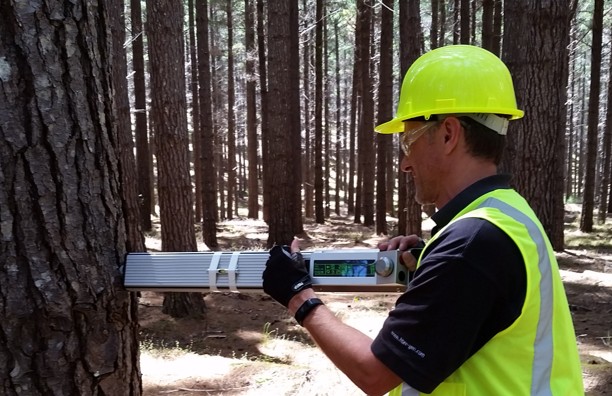
Resistance drilling, combined with web-based processing of traces (e.g. https://forestquality.shinyapps.io/OpenAccess/), has increasingly been utilised by growers in Australia, as research has demonstrated the low-cost, precision and accuracy of the various metrics produced (under and over-bark diameter, basic density, predicted stiffness and acoustic wave velocity) [13,16,17]. The focus of this effort has been to estimate or predict log stiffness, typically using basic density as a surrogate, but increasingly utilising regression models that include additional metrics extracted from the Resi trace related to AWV variance as assessed suing the FibreGen HM200 instrument [18].
References
1. Lachenbruch B, Moore JR, Evans R. Radial Variation in Wood Structure and Function in Woody Plants, and Hypotheses for Its Occurrence. Springer Netherlands; 2011. p. 121–64. Available from:
http://dx.doi.org/10.1007/978-94-007-1242-3_5
2. Gil-Moreno D, McLean JP, Ridley-Ellis D. Models to predict the radial variation of stiffness, strength, and density in planted noble fir, Norway spruce, western hemlock, and western red cedar in Great Britain. Annals of Forest Science [Internet]. 2023;80. Available from:
http://dx.doi.org/10.1186/s13595-023-01214-7
3. Evans R. Rapid Measurement of the Transverse Dimensions of Tracheids in Radial Wood Sections from
Pinus radiata. hfsg [Internet]. 1994;48:168–72. Available from:
http://dx.doi.org/10.1515/hfsg.1994.48.2.168
4. Moore JR, Cown DJ, McKinley RB. Modelling microfibril angle variation in New Zealand-grown radiata pine. New Zealand Journal of Forestry Science [Internet]. 2014;44. Available from:
http://dx.doi.org/10.1186/s40490-014-0025-4
5. Pot G, Viguier J, Olsson A. Evaluating Distance to the Pith as a Parameter for Strength Grading of Douglas Fir (Pseudotsuga menziesii (Mirb.) Franco). Forests [Internet]. 2025;16:504. Available from:
http://dx.doi.org/10.3390/f16030504
6. Kennedy RW. Coniferous wood quality in the future: concerns and strategies. Wood Science and Technology [Internet]. 1995;29. Available from:
http://dx.doi.org/10.1007/bf00202581
7. Pot G, Viguier J, Olsson A. Evaluating Distance to the Pith as a Parameter for Strength Grading of Douglas Fir (Pseudotsuga menziesii (Mirb.) Franco). Forests [Internet]. 2025;16:504. Available from:
http://dx.doi.org/10.3390/f16030504
8. Donaldson LA, Grace J, Downes GM. Within-tree variation in anatomical properties of compression wood in radiata pine. IAWA Journal [Internet]. 2004;25:253–71. Available from:
http://dx.doi.org/10.1163/22941932-90000364
9. Xu P, Donaldson L, Walker J, Evans R, Downes G. Effects of density and microfibril orientation on the vertical variation of low-stiffness wood in radiata pine butt logs. Holzforschung [Internet]. 2004;58:673–7. Available from:
http://dx.doi.org/10.1515/hf.2004.122
10. Watt MS, Zoric B, Kimberley MO, Harrington J. Influence of stocking on radial and longitudinal variation in modulus of elasticity, microfibril angle, and density in a 24-year-old
Pinus radiata thinning trial. Canadian Journal of Forest Research [Internet]. 2011;41:1422–31. Available from:
http://dx.doi.org/10.1139/x11-070
11. Waghorn MJ, Mason EG, Watt MS. Influence of initial stand density and genotype on longitudinal variation in modulus of elasticity for 17-year-old Pinus radiata. Forest Ecology and Management [Internet]. 2007;252:67–72. Available from:
http://dx.doi.org/10.1016/j.foreco.2007.06.019
12. Beets PN, Kimberley MO, Oliver GR, Pearce SH. Predicting wood density of growth increments of Douglas-fir stands in New Zealand. New Zealand Journal of Forestry Science [Internet]. 2018;48. Available from:
http://dx.doi.org/10.1186/s40490-018-0112-z
13. Gendvilas V, Lee DJ, Kain DP, Kumar C, Downes GM, Lausberg M, et al. Predicting Wood Density Using Resistance Drilling: The Effect of Instrument and Operator. Forests [Internet]. 2024;15:157. Available from:
http://dx.doi.org/10.3390/f15010157
14. Watt MS, Garnett BT, Walker JCF. The use of the pilodyn for assessing outerwood density in New Zealand radiata pine. Forest Products Journal. 1996;46:101.
15. Cown DJ, Hutchison JD. Wood density as an indicator of the bending properties of Pinus radiata poles. New Zealand Journal of Forestry Science. 1983;13:87.
16. Downes G, Lee D. Report 32: Discussion paper: Towards improving the prediction of log MOE from resi traces. University of the Sunshine Coast; 2024.
17. Downes GM, Lausberg M, Potts BM, Pilbeam DL, Bird M, Bradshaw B. Application of the IML Resistograph to the infield assessment of basic density in plantation eucalypts. Australian Forestry [Internet]. 2018;81:177–85. Available from:
http://dx.doi.org/10.1080/00049158.2018.1500676
18. Downes G, Lausberg M. Evaluation of the RESI Software tool for the prediction of HM200 within pine logs sourced from multiple sites across New Zealand and Australia. Unpublished [Internet]. 2016; Available from:
https://rgdoi.net/10.13140/RG.2.2.13695.38560